

Why We Lost Our Connection to Healthy Architecture
By Callie Van der Merwe,Behavioural Architect, Founder COOOP.co
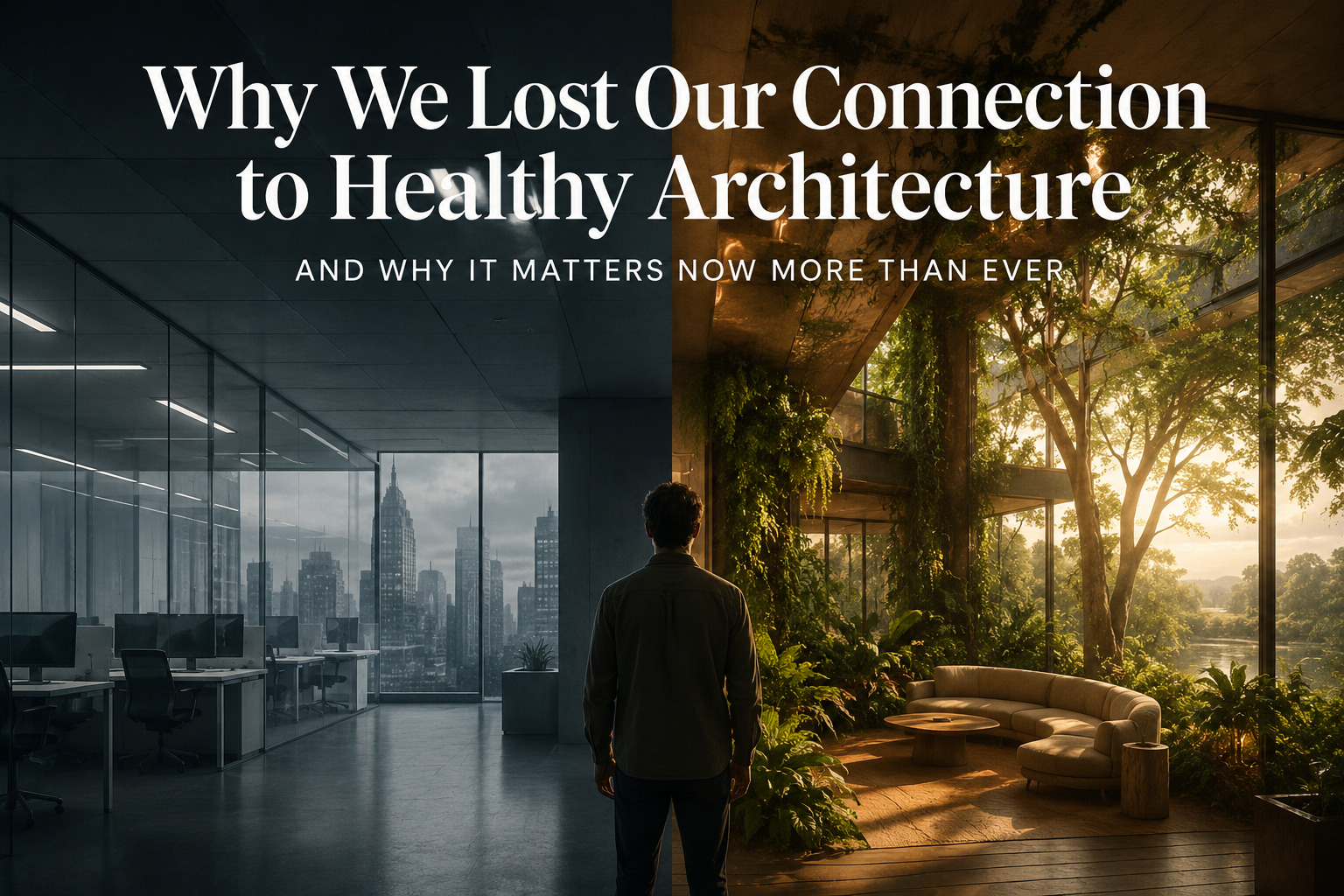
Why it matters now more than ever
There was a time when architecture was not a profession. It was a necessity, a survival tool, a form of intelligence. Before drawings, before codes, before layers of consultants and contractors, there was instinct. Humans built in direct response to wind, sun, water, terrain, danger and opportunity. Architecture was not separate from life, it was life itself. It shaped behaviour, regulated emotion and aligned people with natural rhythms. In many ways architecture was once medicine.
So how did we lose that connection, and more importantly how do we get it back?
For most of human history the environment was not something we entered, it was something we read. People read the sky to predict weather, the land to find shelter, and subtle shifts in light, sound and temperature to survive. This constant engagement sharpened human perception and trained intuition at a deep level. Today our experience of the world is largely mediated. We live through screens instead of landscapes, climate control instead of seasons and artificial light instead of circadian cues. Architecture has followed this shift. Buildings are no longer interfaces between humans and nature, they have become filters and buffers.
The result is that we have outsourced perception, and when perception is outsourced sensitivity dulls.
The modern human now spends close to ninety percent of life indoors. We wake inside a room, enter a vehicle, work in a conditioned environment, shop in enclosed centres and return home under artificial lighting. The body may have adapted technologically, but biologically it is still ancient. The nervous system that once scanned horizons for movement, danger and opportunity now navigates notifications, traffic noise and sensory overload. The body does not fully understand the difference. It still responds chemically and emotionally to environment, whether we are conscious of it or not.
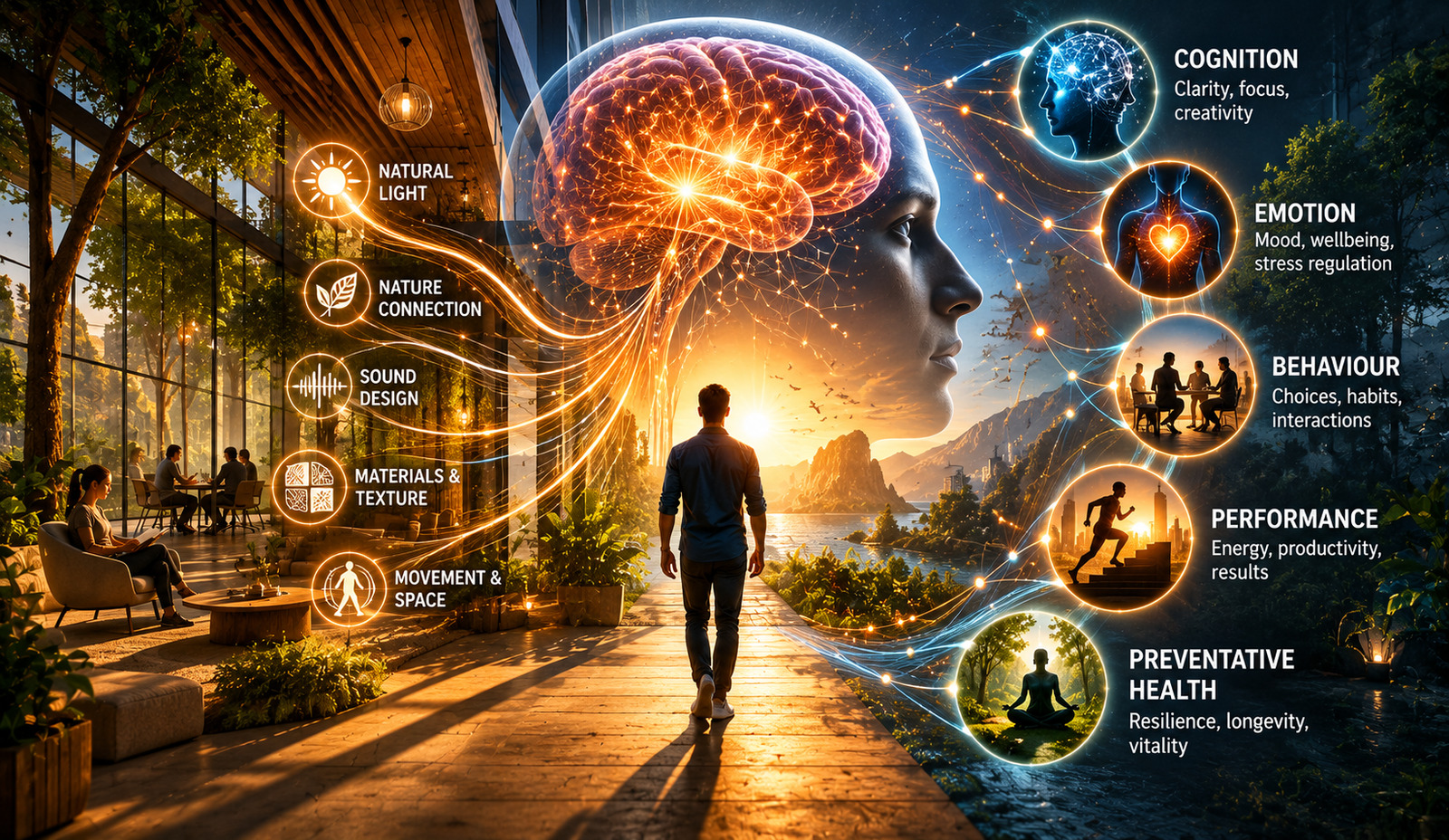
This matters more than most people realise because environments are never neutral. Every space is communicating something to the nervous system. Ceiling heights influence thought patterns. Lighting alters hormone production. Acoustics shape stress levels. Spatial density affects social behaviour. Materials influence emotional warmth and perceived safety. Colour directs attention. Temperature impacts cognition. Even the way a person moves through a space changes how they feel within it.
Architecture is behavioural.
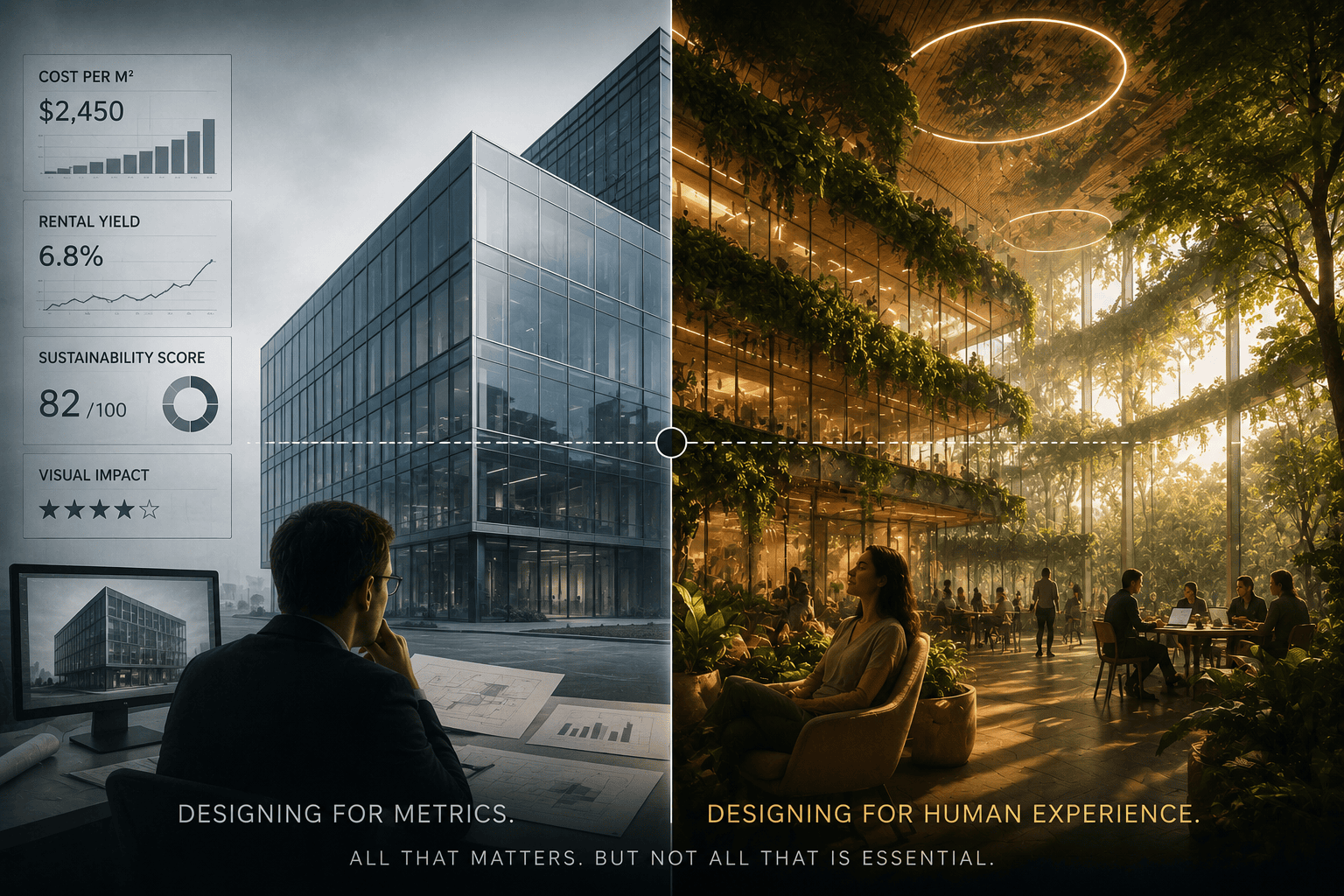
Yet somewhere along the way we reduced it largely to aesthetics, efficiency and commercial optimisation. We began designing buildings as objects rather than experiences. Success became increasingly measured in cost per square metre, rental yield, sustainability metrics and visual impact. All of these things matter, but they are incomplete. Because humans do not experience architecture intellectually first. They experience it biologically first.
Long before we consciously process a space, the body has already reacted to it.
At the same time specialisation has replaced wholeness. There was a time when the designer was also the builder, the observer and the inhabitant. Knowledge was integrated and deeply embodied. Today architecture is fragmented into disciplines and expertise. Architects, interior designers, engineers, lighting consultants, acoustic specialists and sustainability advisors all contribute depth and value. Yet something critical has been lost, and that is wholeness. No single mind holds the entire human experience anymore. This mirrors a broader societal shift where we have traded holistic understanding for specialised excellence.
We have become exceptionally good at optimising parts, but humans do not experience environments in parts. They experience them as systems.
This fragmentation is not necessarily a failure. It is partly the consequence of complexity. Modern buildings are technologically extraordinary. They respond to energy demands, environmental compliance, fire engineering, accessibility standards, digital integration and countless operational requirements. The problem is not the existence of expertise. The problem is that human experience often sits somewhere between all the disciplines rather than at the centre of them.
And the human experience cannot be isolated into a single category.
A beautiful space that creates anxiety is not successful. A highly sustainable building that exhausts people cognitively is not fully healthy. A workplace with perfect technical compliance but poor emotional experience will still underperform. We are beginning to realise that performance is not only operational. It is neurological, emotional and behavioural.
Alongside this, control has replaced participation.
Traditional cultures understood themselves as part of nature rather than separate from it. This worldview shaped how spaces were conceived and built. Systems such as Feng Shui and Vastu Shastra were not aesthetic frameworks, they were behavioural ones that aligned people with energy, orientation and the elements. Indigenous cultures around the world similarly understood shelter not merely as protection, but as relationship. Buildings responded to seasons, wind directions, local materials, solar movement and communal behaviour patterns.
Modern architecture operates on a very different premise. We control temperature, light, sound, air and movement. We engineer environments to perform. This has delivered extraordinary comfort and efficiency, but it has also subtly shifted our relationship with space. We have moved from listening to imposing, from participating to managing, from adapting to controlling.
When we stop listening to the environment, we stop designing with it.
Urban environments have accelerated this shift even further. Cities are extraordinary achievements, engines of culture and innovation, but they are also highly artificial ecosystems. Light cycles are extended, noise is constant, temperature is stabilised and natural variability is reduced. Over time the human nervous system adapts to this as normal. This adaptation comes at a cost. Reduced exposure to natural environments has been shown to impact cognitive performance, stress levels and circadian rhythms.
We do not just live in cities, cities retrain us. They recalibrate what we perceive as comfortable, stimulating and safe, and in doing so they quietly disconnect us from the biological rhythms we evolved with.
The consequences are increasingly visible.
Anxiety disorders, burnout, attention fatigue, loneliness and sleep dysfunction are all rising globally. Of course architecture is not solely responsible for these conditions, but it undeniably participates in them. Human beings are environmental creatures. We are shaped by what surrounds us. Every environment either supports or suppresses us at some level.
This is why the future conversation around design cannot simply be about beauty or sustainability alone. It must increasingly become about human performance and human wellbeing in the deepest sense of the word.
At the same time abstraction has distanced us from meaning.
We now understand the world in extraordinary scientific detail. We can model the universe, map the genome and simulate complex systems. Yet most of this knowledge is abstract and removed from lived experience. Ancient cultures may not have understood the stars scientifically, but they felt deeply connected to them. They navigated by them, told stories about them and structured life around them.
Today we know more but often feel less.
Architecture reflects this shift. We design through drawings, data, metrics and standards. All of these are powerful and necessary, yet increasingly removed from the human experience of space. We have moved from embodied experience to intellectual abstraction and in doing so we have distanced ourselves from meaning.
Certification systems such as WELL, LEED and BREEAM have emerged as global benchmarks. WELL focuses on human health and wellbeing through factors such as air quality, water, nourishment, light, fitness and comfort. LEED has driven sustainability at scale by addressing energy efficiency, materials, water use and environmental impact. BREEAM has similarly provided rigorous frameworks for assessing environmental performance across the lifecycle of buildings. These systems have fundamentally improved how we design and deliver spaces and have elevated the conversation around health, sustainability and responsibility.
Yet despite this progress there remains a critical gap.
These systems measure what we can see and quantify in physical and environmental terms, but they do not fully capture what happens inside the human mind. They do not measure how a space is actually processed neurologically, how it shapes emotion in real time or how it drives behaviour at a subconscious level. In other words we have developed sophisticated ways to certify buildings as healthy, but we have not yet established a standardised system to measure our neural responses to those environments.
We know how a building performs, but we do not yet consistently measure how a human performs within it.
This may become one of the defining design conversations of the next decade.
Because neuroscience is beginning to reveal something profound. Human beings are not passive occupants of space. We are constantly interacting with environment through the nervous system. The brain continuously scans surroundings for signals of safety, threat, belonging, stimulation and opportunity. Much of this happens below conscious awareness. A person may walk into a room and simply say it “feels good” or “feels uncomfortable” without fully understanding why. Yet underneath that reaction are thousands of neurological calculations occurring in real time.
The implications for architecture are enormous.
If environments shape cognition, emotion and behaviour, then design is no longer merely decoration or shelter. It becomes a performance tool. A behavioural tool. Potentially even a preventative health tool.
This is where concepts such as Envirohacking begin to emerge as part of a larger global shift. The idea that environments can be intentionally curated to optimise cognitive, emotional and physiological performance is not futuristic. It is already happening, whether consciously or unconsciously. Retail environments influence spending behaviour. Hospitality spaces shape mood and memory. Healthcare environments impact recovery. Workplaces influence productivity and collaboration. Educational environments affect learning outcomes. Luxury residential design influences emotional regulation and wellbeing.
The question is no longer whether environments shape us.
The question is whether we are willing to engage with that reality intentionally.
It would be easy to frame this as a story of decline, to suggest that we have lost our way, but that would not be entirely accurate. What we have really done is reallocate attention. We have shifted from survival to innovation, from intuition to analysis and from immersion to abstraction. These shifts have given us medicine, technology, global communication and complex forms of architecture that would have once been unimaginable. The issue is not what we have gained, but what we have stopped exercising.
The most important insight is that this capacity has not disappeared. It is simply dormant.
When people spend time in nature, reduce sensory overload, engage physically with their environment and observe natural cycles rather than rigid schedules, something remarkable happens. Attention sharpens, stress reduces, awareness increases and intuition begins to return. The human system remembers far more quickly than we expect.
You can see it almost immediately. People breathe differently near water. They slow down in forests. They linger in spaces with warmth, texture and natural light. They avoid harsh acoustics, oppressive density and environments that feel emotionally sterile. The body is constantly giving feedback.
We simply stopped listening carefully enough.
This is where the future of architecture can become incredibly powerful. We are now in a position where we have scientific evidence from neuroscience, behavioural psychology and environmental research, combined with advanced design capability and real world environments in which to test ideas at scale. What has been missing is integration.
What is emerging now is not entirely new. It is a return.
A return to the understanding that space is not neutral, that design is not passive and that architecture is deeply human. It shapes us as much as we shape it.
The architects, designers and brands that will lead the future are unlikely to be those who simply create the most visually striking spaces. AI will increasingly democratise visual design. Beautiful imagery will become abundant. The real differentiation will not come from aesthetics alone. It will come from understanding human beings more deeply.
The future of architecture will belong to those who understand how environments change behaviour.
Those who understand how attention works. How emotion works. How sensory systems work. How nervous systems regulate. How memory forms. How environments influence trust, stress, productivity, belonging and wellbeing.
Because ultimately people do not remember spaces exactly as they were. They remember how those spaces made them feel. We do not see things as they are, we see them as we are.
Architecture has always operated on this principle, even if unconsciously. Now we have the opportunity to engage with it consciously and deliberately. If what we see can change how we feel, and how we feel can change how we behave, then the environments we create are not just backdrops to life, they are active participants in it.
And perhaps that is the deeper realisation emerging now.
Healthy architecture is not about adding wellness features onto buildings. It is about rediscovering the ancient understanding that environments shape human life itself. Not symbolically, but biologically, emotionally and behaviourally.
We have spent decades designing buildings around machines and systems.The next era may finally be about designing them around humans again.
This fragmentation is not necessarily a failure. It is partly the consequence of complexity. Modern buildings are technologically extraordinary. They respond to energy demands, environmental compliance, fire engineering, accessibility standards, digital integration and countless operational requirements. The problem is not the existence of expertise. The problem is that human experience often sits somewhere between all the disciplines rather than at the centre of them.
And the human experience cannot be isolated into a single category.
A beautiful space that creates anxiety is not successful. A highly sustainable building that exhausts people cognitively is not fully healthy. A workplace with perfect technical compliance but poor emotional experience will still underperform. We are beginning to realise that performance is not only operational. It is neurological, emotional and behavioural.
Alongside this, control has replaced participation.
Traditional cultures understood themselves as part of nature rather than separate from it. This worldview shaped how spaces were conceived and built. Systems such as Feng Shui and Vastu Shastra were not aesthetic frameworks, they were behavioural ones that aligned people with energy, orientation and the elements. Indigenous cultures around the world similarly understood shelter not merely as protection, but as relationship. Buildings responded to seasons, wind directions, local materials, solar movement and communal behaviour patterns.
Modern architecture operates on a very different premise. We control temperature, light, sound, air and movement. We engineer environments to perform. This has delivered extraordinary comfort and efficiency, but it has also subtly shifted our relationship with space. We have moved from listening to imposing, from participating to managing, from adapting to controlling.
When we stop listening to the environment, we stop designing with it.
Urban environments have accelerated this shift even further. Cities are extraordinary achievements, engines of culture and innovation, but they are also highly artificial ecosystems. Light cycles are extended, noise is constant, temperature is stabilised and natural variability is reduced. Over time the human nervous system adapts to this as normal. This adaptation comes at a cost. Reduced exposure to natural environments has been shown to impact cognitive performance, stress levels and circadian rhythms.
We do not just live in cities, cities retrain us. They recalibrate what we perceive as comfortable, stimulating and safe, and in doing so they quietly disconnect us from the biological rhythms we evolved with.
The consequences are increasingly visible.
Anxiety disorders, burnout, attention fatigue, loneliness and sleep dysfunction are all rising globally. Of course architecture is not solely responsible for these conditions, but it undeniably participates in them. Human beings are environmental creatures. We are shaped by what surrounds us. Every environment either supports or suppresses us at some level.
This is why the future conversation around design cannot simply be about beauty or sustainability alone. It must increasingly become about human performance and human wellbeing in the deepest sense of the word.
At the same time abstraction has distanced us from meaning.
We now understand the world in extraordinary scientific detail. We can model the universe, map the genome and simulate complex systems. Yet most of this knowledge is abstract and removed from lived experience. Ancient cultures may not have understood the stars scientifically, but they felt deeply connected to them. They navigated by them, told stories about them and structured life around them.
Today we know more but often feel less.
Architecture reflects this shift. We design through drawings, data, metrics and standards. All of these are powerful and necessary, yet increasingly removed from the human experience of space. We have moved from embodied experience to intellectual abstraction and in doing so we have distanced ourselves from meaning.
Certification systems such as WELL, LEED and BREEAM have emerged as global benchmarks. WELL focuses on human health and wellbeing through factors such as air quality, water, nourishment, light, fitness and comfort. LEED has driven sustainability at scale by addressing energy efficiency, materials, water use and environmental impact. BREEAM has similarly provided rigorous frameworks for assessing environmental performance across the lifecycle of buildings. These systems have fundamentally improved how we design and deliver spaces and have elevated the conversation around health, sustainability and responsibility.
Yet despite this progress there remains a critical gap.
These systems measure what we can see and quantify in physical and environmental terms, but they do not fully capture what happens inside the human mind. They do not measure how a space is actually processed neurologically, how it shapes emotion in real time or how it drives behaviour at a subconscious level. In other words we have developed sophisticated ways to certify buildings as healthy, but we have not yet established a standardised system to measure our neural responses to those environments.
We know how a building performs, but we do not yet consistently measure how a human performs within it.
This may become one of the defining design conversations of the next decade.
Because neuroscience is beginning to reveal something profound. Human beings are not passive occupants of space. We are constantly interacting with environment through the nervous system. The brain continuously scans surroundings for signals of safety, threat, belonging, stimulation and opportunity. Much of this happens below conscious awareness. A person may walk into a room and simply say it “feels good” or “feels uncomfortable” without fully understanding why. Yet underneath that reaction are thousands of neurological calculations occurring in real time.
The implications for architecture are enormous.
If environments shape cognition, emotion and behaviour, then design is no longer merely decoration or shelter. It becomes a performance tool. A behavioural tool. Potentially even a preventative health tool.
This is where concepts such as Envirohacking begin to emerge as part of a larger global shift. The idea that environments can be intentionally curated to optimise cognitive, emotional and physiological performance is not futuristic. It is already happening, whether consciously or unconsciously. Retail environments influence spending behaviour. Hospitality spaces shape mood and memory. Healthcare environments impact recovery. Workplaces influence productivity and collaboration. Educational environments affect learning outcomes. Luxury residential design influences emotional regulation and wellbeing.
The question is no longer whether environments shape us.
The question is whether we are willing to engage with that reality intentionally.
It would be easy to frame this as a story of decline, to suggest that we have lost our way, but that would not be entirely accurate. What we have really done is reallocate attention. We have shifted from survival to innovation, from intuition to analysis and from immersion to abstraction. These shifts have given us medicine, technology, global communication and complex forms of architecture that would have once been unimaginable. The issue is not what we have gained, but what we have stopped exercising.
The most important insight is that this capacity has not disappeared. It is simply dormant.
When people spend time in nature, reduce sensory overload, engage physically with their environment and observe natural cycles rather than rigid schedules, something remarkable happens. Attention sharpens, stress reduces, awareness increases and intuition begins to return. The human system remembers far more quickly than we expect.
You can see it almost immediately. People breathe differently near water. They slow down in forests. They linger in spaces with warmth, texture and natural light. They avoid harsh acoustics, oppressive density and environments that feel emotionally sterile. The body is constantly giving feedback.
We simply stopped listening carefully enough.
This is where the future of architecture can become incredibly powerful. We are now in a position where we have scientific evidence from neuroscience, behavioural psychology and environmental research, combined with advanced design capability and real world environments in which to test ideas at scale. What has been missing is integration.
What is emerging now is not entirely new. It is a return.
A return to the understanding that space is not neutral, that design is not passive and that architecture is deeply human. It shapes us as much as we shape it.
The architects, designers and brands that will lead the future are unlikely to be those who simply create the most visually striking spaces. AI will increasingly democratise visual design. Beautiful imagery will become abundant. The real differentiation will not come from aesthetics alone. It will come from understanding human beings more deeply.
The future of architecture will belong to those who understand how environments change behaviour.
Those who understand how attention works. How emotion works. How sensory systems work. How nervous systems regulate. How memory forms. How environments influence trust, stress, productivity, belonging and wellbeing.
Because ultimately people do not remember spaces exactly as they were. They remember how those spaces made them feel. We do not see things as they are, we see them as we are.
Architecture has always operated on this principle, even if unconsciously. Now we have the opportunity to engage with it consciously and deliberately. If what we see can change how we feel, and how we feel can change how we behave, then the environments we create are not just backdrops to life, they are active participants in it.
And perhaps that is the deeper realisation emerging now.
Healthy architecture is not about adding wellness features onto buildings. It is about rediscovering the ancient understanding that environments shape human life itself. Not symbolically, but biologically, emotionally and behaviourally.
We have spent decades designing buildings around machines and systems.The next era may finally be about designing them around humans again.