
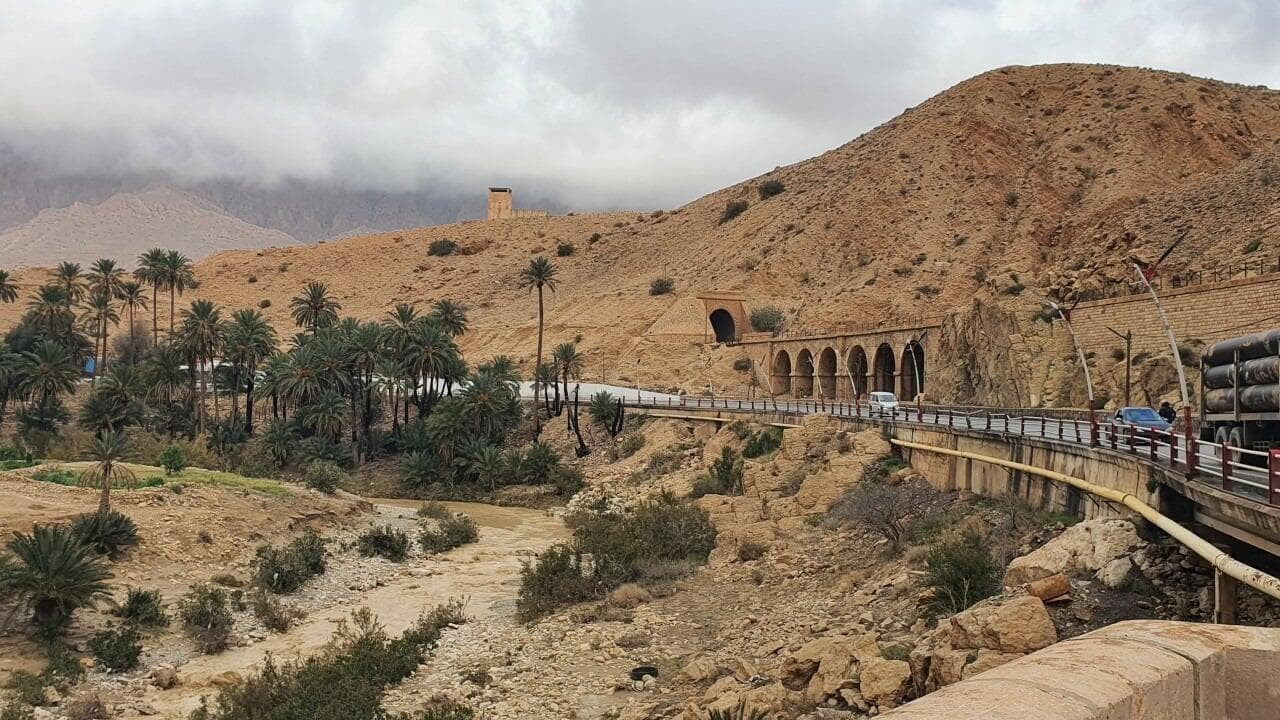
The Circle of Return: A passion for architecture and construction born in the sands!
As told by Alain Chazelles | CEO, InHouseGroup3 Pty Ltd
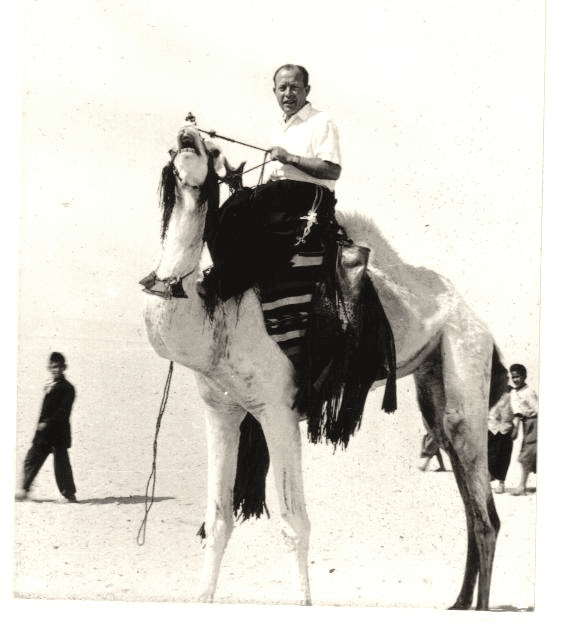
Maurice Chazelles — in the Sahara he never stopped belonging to. Image: Alain Chazelles,
personal collection.
A forgotten message from 2012, buried in digital silence for twelve years, would become the key that unlocked a lifetime of memories.
Alain had never been one to frequent Facebook Messenger. The account existed, but like an unopened drawer in a seldom-used desk, it gathered digital dust while life moved forward. When a friend's message finally drew him to the platform, he found something unexpected: a small collection of unread messages. Most were meaningless. But one would change everything.
It came from Touggourt, the city of his childhood in the Sahara, from a man named AbdelMalek Saoud. The date stamp read 2012. Twelve years of silence had stretched between the sending and the reading, yet the warmth in those words transcended time. Alain responded with apologies for the extraordinary delay. AbdelMalek's reply carried no reproach. Only excitement, recognition, and an invitation to reconnect with a past that had shaped him more deeply than he had ever realised.
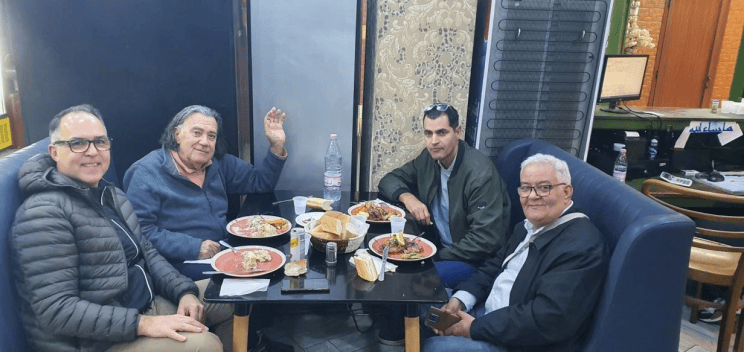
Alain Chazelles and AbdelMalek Saoud sharing a meal in Constantine. Image: Alain Chazelles, personal collection.
AbdelMalek was not merely a voice from the past. As a French teacher and researcher dedicated to documenting the French presence in the Sahara, he had been studying Alain's family for years. His finding was startling: this family, scattered by the winds of independence and time, was still remembered across the region as renowned for their commitment and good deeds. What had seemed like ancient history to Alain was a living memory to AbdelMalek.
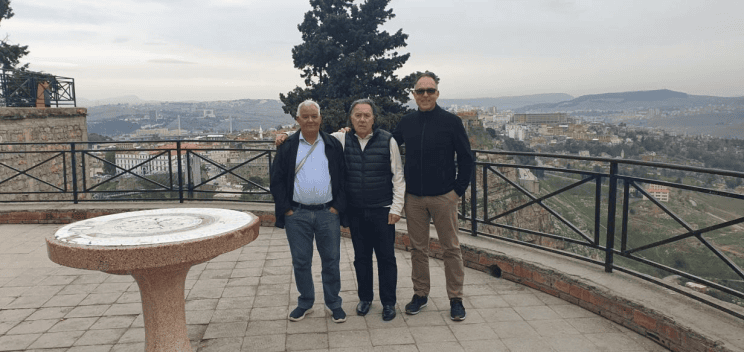
Alain Chazelles with his nephew and AbdelMalek Saoud in Constantine (birthplace of Alain). Image: Alain Chazelles, personal collection.

To understand why, you have to go back much further. To a story AbdelMalek has spent years ensuring is not forgotten.
Roots in the Sahara


The Chazelles family name carried weight across the Algerian Sahara. Not through wealth or political authority. Through consistent acts of service and integrity that earned respect from every community they touched. In a landscape where relationships mattered as much as competence and trust was earned through daily actions rather than proclaimed through titles, that reputation was the most durable thing a family could build.
Alain's father embodied those values. Growing up in Touggourt, Alain absorbed them without fully knowing it. The privilege was not of material comfort but of belonging to a community that knew your family's name and what it stood for.
It was a reputation forged in moments that most people would never face. The most extraordinary of those moments belonged to Alain's grandfather, Henri Chazelles. It is a story that AbdelMalek Saoud has taken particular care to preserve.


A Journey into the Desert

As documented by AbdelMalek Saoud, researcher — French presence in the Algerian Sahara
The son of Mr Masralli — the closest friend of Henri Chazelles — was killed in a remote sector of the desert. Caught in a skirmish against foreign belligerents fighting over Saharan trade routes and oases, his caravan was overwhelmed and destroyed. His body was left where it fell, deep in enemy-held territory.
It was the dead of the Saharan summer. Ground temperatures regularly exceeded 50°C. Military commanders declared any retrieval mission impossible. Suicidal, in their assessment. The desert in those conditions was not a terrain to cross voluntarily. It was a terrain to survive.

Driven by a loyalty that overrode every calculation of personal safety, Chazelles made a vow to Mr Masralli: he would venture into enemy territory and bring his son home for a proper burial.
He organised a caravan of thirty-five elite méharistes, hardened Tuareg and local Saharan camel riders who knew the hidden water points, the gueltas buried in the rock, and who could navigate by stars across terrain that erased its own tracks. The caravan was stripped to essentials: water skins, light rifles, and the specialised rigging on a designated méhari to carry the body back through the dunes.
What followed over the next seventeen days has been preserved in the oral histories that AbdelMalek has spent years collecting. The caravan battled severe dehydration and blinding sandstorms. The constant threat of ambush from the same belligerents who had killed the young man shadowed every hour of the crossing.
Henri Chazelles led his thirty-five riders through all of it. They located the battlefield. They recovered the body of Masralli's son. And they executed a harrowing retreat back through the Saharan summer to return him to his family.

For AbdelMalek, this is not an anecdote. It is the defining entry in his documentation of the Chazelles family. It explains why, more than sixty years after they left, the name is still spoken of with reverence.
For Alain, hearing it in 2024 was a different kind of reckoning. He had always known his family was remembered. He had not known what they were remembered for.
The Great Disruption

The year 1962 arrived like a sudden sandstorm. Algerian independence forced a choice on every family rooted in the Saharan community: adapt to an entirely new reality, or seek refuge elsewhere.
The family regrouped in Provence. But Alain's father stayed behind, bound by the cooperation agreements of the Évian Accords, part of the technical assistance program helping the newly independent Algeria maintain essential services. Three more years in the Sahara, without his family. Not abandonment: obligation. A final service to both nations during one of history's most complex transitions.

On July 2, 1962, Alain boarded a transatlantic liner bound for Marseille with thousands of fellow countrymen fleeing the war in Algeria. In 48 hours, everything changed. After the heat and vastness of the Sahara, Provence felt unfamiliar in every way — temperatures below zero, a grey sky, a silence of a different kind. Reunited with his sisters Françoise and Élisabeth in Uzès, the family understood that nothing could be undone.
Loss and Transformation
When Maurice finally returned to France in 1965, the strain of those years had taken its toll. Within a year, illness set in.
In 1967, while Alain was serving his mandatory two years of military duty, his father died in Menton. The timing was cruel in the particular way that life sometimes is: at the very moment he was learning about duty and what it means to honour a commitment under pressure, he lost the man who had exemplified those qualities every day of his life.
Alain completed his service. He came home to what remained. And then he began to build.
Building Across Borders
Emerging from military service in 1969, Alain faced the question that confronts every generation at its turning point: what do you build from what remains?
By 1974, Alain had found love and marriage. In 1976, his daughter Laurie was born. The year 1977 marked the beginning of his entrepreneurial life. Between then and his move to Australia, he founded three businesses.
Two were based in France, specialising in interior decoration and furnishings. His Monaco practice focused exclusively on architecture and interior design for luxury residential projects and prestigious international brands including Escada, Cerruti 1881, Laurel and Eden Park — across France's capital cities and Monaco.
The principle that carried him through each was the same one the Sahara had taught: earn trust through what you do, not what you claim.
The Australian Vision
Australia had always exerted a quiet pull on Alain. After spending eighteen months there in 1969, he returned to Europe carrying a promise to himself: one day he would come back and make Australia his home. Thirty years later, he fulfilled that promise. It became one of the defining decisions of his life.
In 1999, Alain made his most consequential decision: emigration to Australia. A continent built by people who had arrived from elsewhere. A place where a background shaped by movement, reinvention and the crossing of boundaries was not a liability but a credential. For someone formed entirely by that kind of life, it was the right place at the right time.
The Message That Completed the Circle
When AbdelMalek's message finally reached its destination in 2024, it confirmed that the Chazelles family's reputation had not merely survived sixty-four years of absence. It had become part of the region's documented historical record.


The discovery became a desire to reconnect with the last survivors of his generation who may still be alive after 64 years of absence. The boy who had left Touggourt in 1962 could return not as someone seeking sympathy for what was lost, but as someone who had spent six decades honouring, through every choice and every enterprise built, the values the Sahara had given him.
What became InHouseGroup3 was never a commercial calculation. It was a continuation.

Legacy in Motion
From the Saharan community that still speaks of Henri Chazelles' loyalty to the professional relationships Alain has built throughout his life in Australia, the through-line remains the same: build something worthy, serve others honestly, and hold to integrity regardless of the circumstances.
Thirty-five men crossed fifty-degree dunes for seventeen days because one man understood what honour required. That story has outlasted empires, borders and sixty years of silence. It is still being told.
Some things carry forward not because they are preserved, but because they are lived. The circle is not yet closed. It is still in motion.

“But the circle’s next turn would take Alain back to the place where it began. In Part II, he revisits Touggourt after sixty-four years away—to the streets and landscapes of his childhood, to the people who gathered to welcome him home, and to the memories that had travelled with him across a lifetime. The journey continues in “Returning to Touggourt: Sixty-Four Years Later.”